.png)
The 2026 FIFA World Cup arrives in the United States as the largest sporting event ever hosted on American soil. For streaming TV advertisers, that represents an extraordinary opportunity — but not necessarily the one most media plans are built around.
Most World Cup advertising strategies will concentrate budget on live match inventory. That is understandable. Live sports command premium attention, and the World Cup is the most-watched sporting event on the planet. But focusing exclusively on live inventory means competing for a fraction of the total attention the tournament generates, at peak CPM rates, with limited ad inventory per match.
There is a better strategy. It requires understanding where World Cup attention actually lives.
The Attention Is Bigger Than the Broadcast
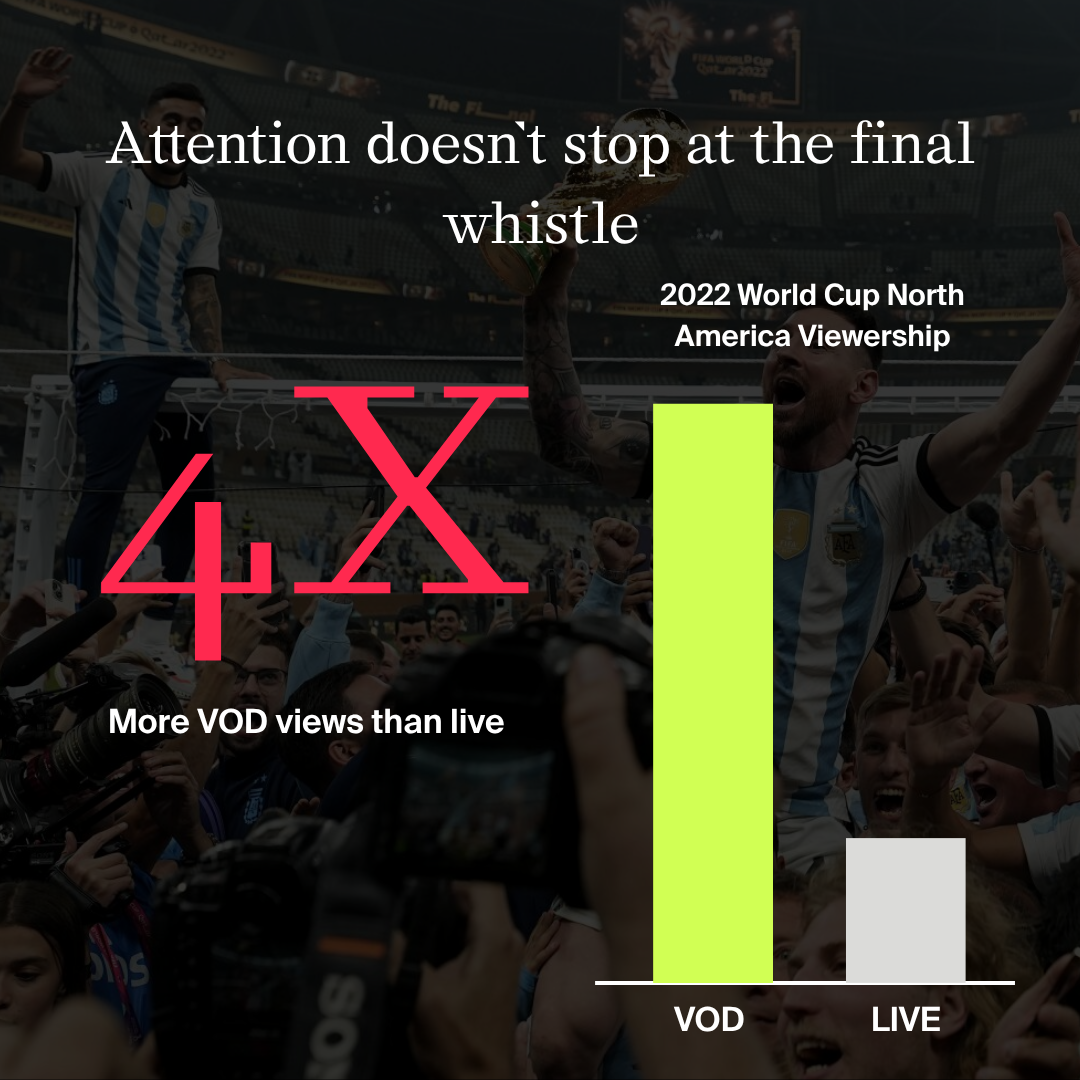
In 2022, short-form video-on-demand generated four times more views than live coverage in North America. Fans did not just watch the match. They returned repeatedly to highlights, recaps, player profiles, reaction content, and personality-driven stories for weeks surrounding the tournament.
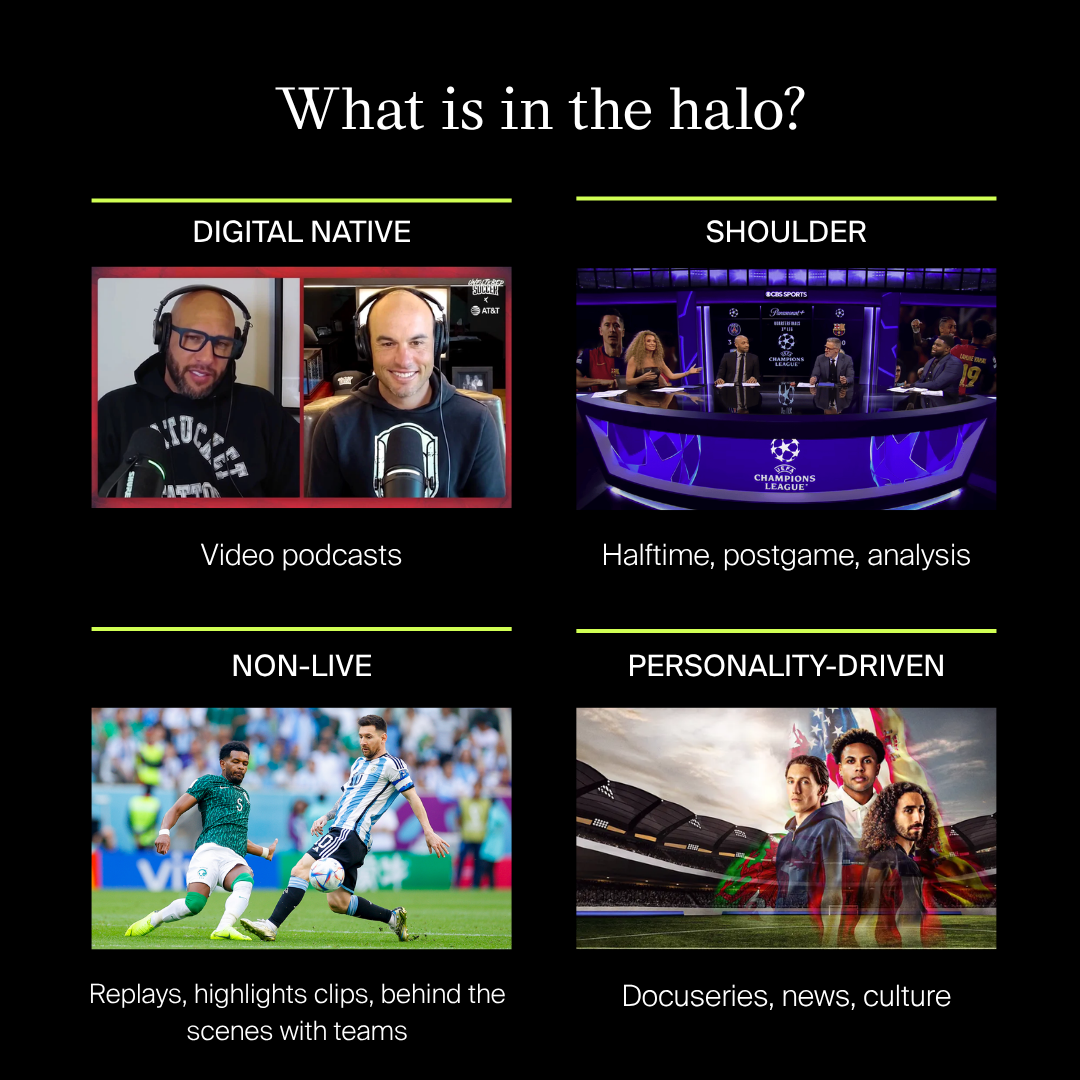
This is what we call the Halo of Relevant Attention. It is the full ecosystem of content that surrounds a major sporting event — digital-native, shoulder programming, non-live, and culture-driven content that reaches audiences across free ad-supported streaming services before, during, and after the games themselves.
For advertisers, the Halo is not a consolation prize for brands that could not afford live rights. It is a strategic opportunity that, when activated correctly, delivers superior reach, better contextual relevance, and measurable performance outcomes.
The U.S. Opportunity Is Larger Than Any Previous Tournament
The potential audience for 2026 is substantial. 87 million Americans are interested in the World Cup, including 34 million female fans, 17 million Hispanic supporters, and 12 million Black enthusiasts. 76% of U.S. World Cup viewers are Gen Z or Millennials — audiences who prefer free ad-supported streaming, have been impacted by account-sharing crackdowns, and consume sports content primarily through digital-native formats.
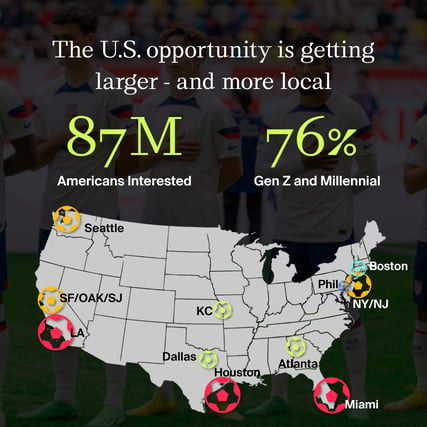 Critically, the tournament is being hosted across 11 U.S. cities. That creates hyper-local intensity that previous World Cups held abroad could not generate. Host markets, including Los Angeles, Miami, Dallas, Houston, New York and New Jersey, and Atlanta, already over-index on soccer fandom. Diaspora communities in those markets — Colombian fans in South Florida, Mexican-American communities in Texas, Ecuadorian supporters in the New York corridor — will mobilize around their national teams in ways that create precision targeting opportunities unique to this tournament.
Two Paths to the Halo: Sponsors and Challengers
One of the most important strategic insights for 2026 is that official sponsorship status does not determine whether a brand can win the tournament. It determines which path they take.
Official sponsors should use the Halo to amplify their live investment — extending moments from the broadcast into always-on contextual presence across the full tournament arc. Overconcentration on live inventory caps their total reach. The Halo removes that ceiling.
Non-sponsors have an equally compelling path. By owning the content ecosystem surrounding the tournament rather than the event itself — reaction content, analysis, player profiles, entertainment crossover programming — challenger brands can conquest relevant attention at scale without paying for official rights.
Regardless of sponsorship status, the brands that win 2026 will be those that plan the full tournament arc rather than the 90 minutes.
Three Phases, One Strategy
World Cup fan attention does not start at kickoff. It builds across three distinct phases that each present different opportunities.
The Anticipation phase, covering the one to two weeks before the tournament begins, offers lower CPMs and high contextual relevance. Squad announcements, host city content, and cultural buildup create natural moments for brands to establish presence before competition for inventory peaks.
The Immersion phase spans the six weeks of the tournament itself. This is peak fan engagement, highest demand, and the moment to deploy Halo channels at full scale alongside any live investment.
The Reverberation phase extends two to four weeks after the Final. Retrospectives, champion celebration content, and fan community activation continue at lower competition levels, offering extended reach for brands willing to sustain presence beyond the closing match.
Fragmentation Has Been the Barrier. Context Is the Solution.
The challenge for advertisers wanting to reach World Cup halo audiences at scale has always been fragmentation. Halo content lives across dozens of streaming publishers — Tubi, Peacock, Pluto TV, Univision, ESPN+, YouTube, and more. Buying it publisher by publisher makes consistent reach, measurement, and optimization nearly impossible.
IRIS.TV's IRIS_ID solves this by standardizing video-level content categorization across the streaming ecosystem. AI models scan sight, sound, and motion data to assign standardized categories to every streaming asset, enabling advertisers to deploy programmatic and spot budgets consistently across the full supply landscape.
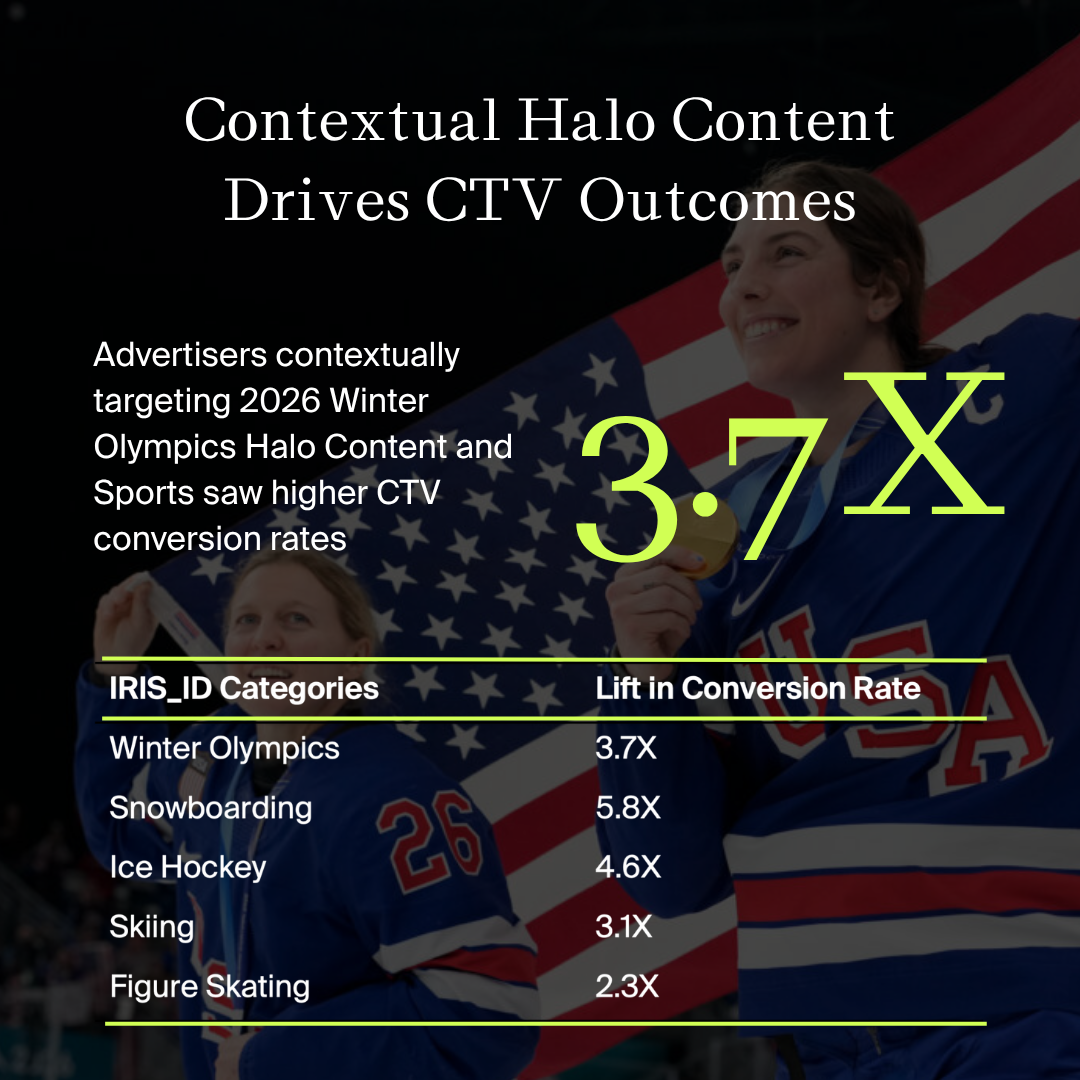
Advertisers using IRIS_ID contextual targeting during the 2026 Winter Olympics saw over 3.7X lift in conversion rates compared to baseline CTV targeting.
The Anticipation Phase Is Already Showing Up in the Data
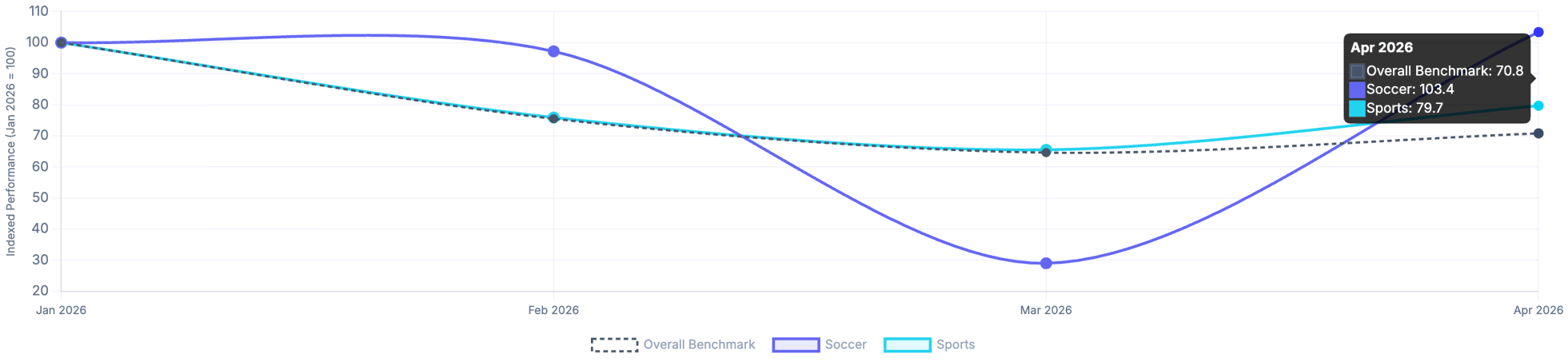
The three-phase framework described in this paper is not theoretical. We can see it happening in real time on the IRIS.TV platform.
In 2026, soccer contextual category conversion rates align with major World Cup qualifying events. The trajectory has outpaced both the broader Sports contextual category and the overall streaming benchmark — and the acceleration is steepening, not flattening, as the tournament approaches.
This matters for two reasons. First, it confirms that fan attention and purchase intent around soccer content are building well before kickoff, exactly as the Anticipation phase framework predicts. Second, it means advertisers who activate contextual soccer targeting now are entering a rising market rather than waiting to compete at its peak.
The brands currently running against soccer contextual inventory are capturing conversion rates above benchmark in a period that most media plans have not yet activated. When the Immersion phase begins, and CPMs rise to meet demand, those brands will have already built frequency, contextual relevance, and audience familiarity that late entrants cannot replicate by spending more.
The data also illustrates the precision advantage of contextual category targeting. The "Soccer" category is now outperforming the broader "Sports" category by a meaningful margin. That gap reflects the difference between reaching a generally sports-interested audience and reaching an audience whose attention is specifically focused on content most closely aligned with World Cup fan behavior.
The Window Is Open.
IRIS.TV platform data shows soccer contextual conversion rates have nearly tripled since September 2025 and are now running above both Sports and overall streaming benchmarks. The Anticipation phase is not coming. It is here.
Brands that activate contextual halo strategies now will capture lower CPMs, stronger contextual relevance, and greater reach than those who wait for kickoff. The framework below covers everything needed to build that strategy — audience insights, phase-based budget allocation, local market targeting, brand vertical mapping, and the contextual categories driving the strongest performance outcomes.

.png)